Could AI Ever Memorize All of Pi?
Everywhere you look, AI is breaking records: writing essays, beating humans at games, and helping crunch numbers at scales that used to sound like science fiction. So it’s natural to wonder: if AI is so powerful, could it ever memorize all of pi?
Pi isn’t just a quirky 3.14 on a classroom poster. It’s the most famous irrational number in mathematics, woven into circles, waves, and orbits. And its digits feel like the perfect playground for both supercomputers and students. On one end, massive AI‑driven systems are pushing pi into the hundreds of trillions of digits. On the other hand, tools like PracticePi let people track their own digital records from a device.
What happens when you put those two worlds side by side: AI’s raw computing power and the human brain’s clever memory tricks? That’s exactly the journey this post takes: from what pi really is, to how far machines have pushed it, to what “memorizing” even means for humans, algorithms, and anyone brave enough to try.
Could AI Ever Memorize All of Pi?
Pi is not just a long number; it’s an irrational number. That means:
Its decimal expansion goes on forever.
The digits never fall into a repeating pattern.
In other words, there is no “final digit” to reach. No matter how far you go, there’s always another digit of pi waiting beyond the horizon.
So when we ask, “Can AI memorize all of pi?”, we’re really asking whether any system: human, machine, or alien- could store an infinite amount of information. The short answer is no. But AI can do things with pi that no human brain will ever match, and that’s where the story gets interesting.
How Far Have Computers Pushed Pi?
In the last decade, computers have blown past anything humans could do by hand:
In 2022, Google Cloud computed 100 trillion digits of pi using high‑performance cloud infrastructure.
In early 2025, researchers reported computing over 120 trillion digits, improving both algorithms and hardware efficiency.
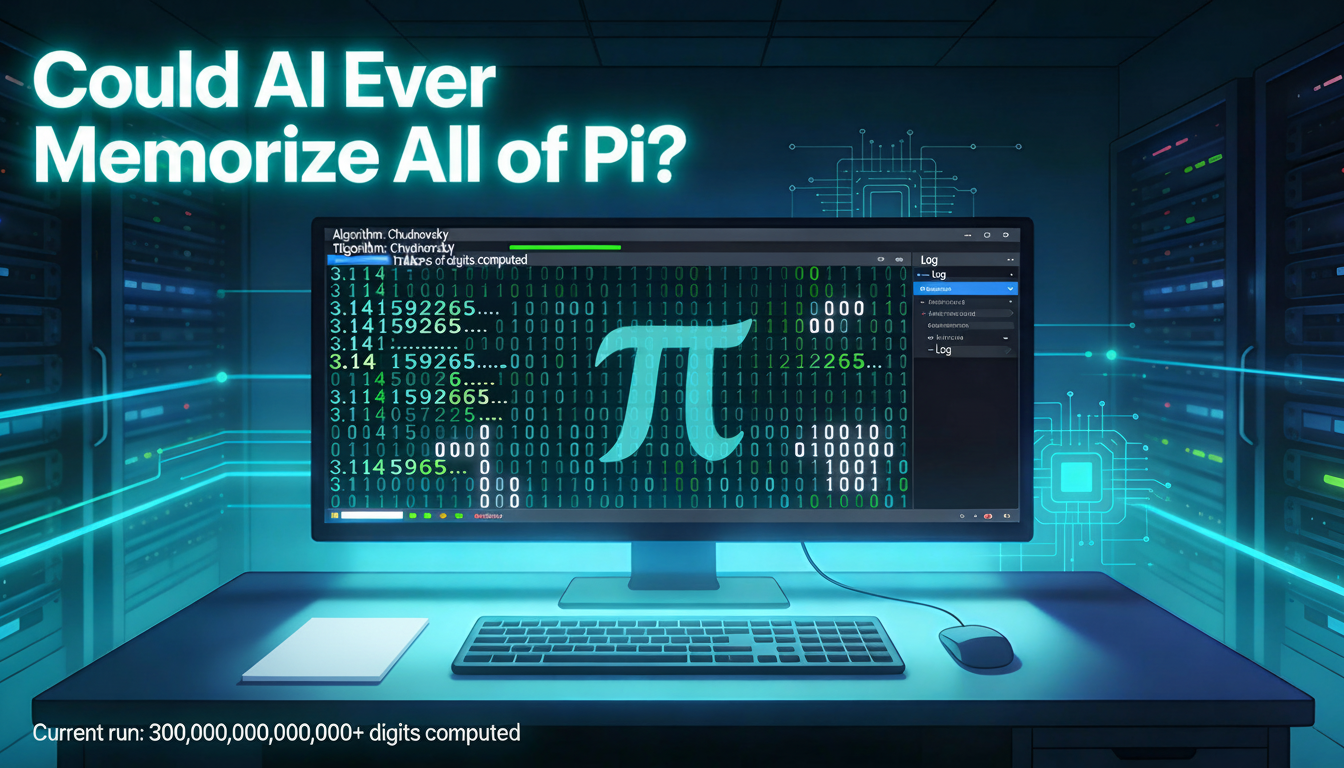
By mid‑2025, a collaboration involving Linus Tech Tips and storage vendors hit an official record of 300 trillion digits of pi.
Later that year, a single high‑end server using the Chudnovsky algorithm and y‑cruncher reportedly reached 314 trillion digits, a symbolic nod to 3.14.
These feats rely on:
Highly optimized algorithms like the Chudnovsky algorithm, which converges to pi extremely fast.
Massive storage systems measured in hundreds of terabytes or more, plus petabytes of I/O over months of computation.
So yes, AI systems can generate and store enormous slices of pi. But there’s a difference between having data on disk and memorizing it in the way we use that word for people.
What “Memorizing Pi” Means for Humans vs AI
When a human “memorizes pi,” three things are happening:
Encoding
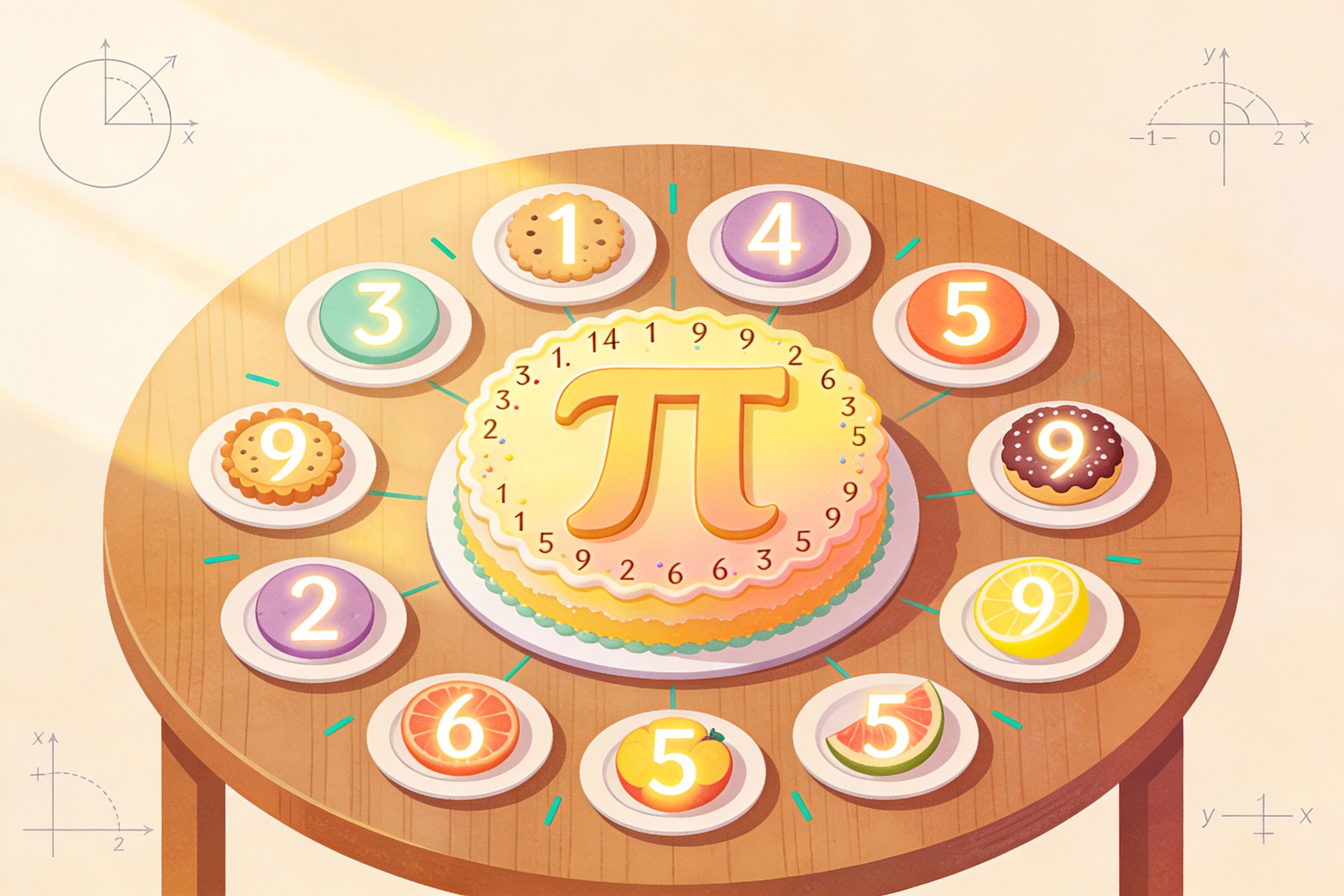
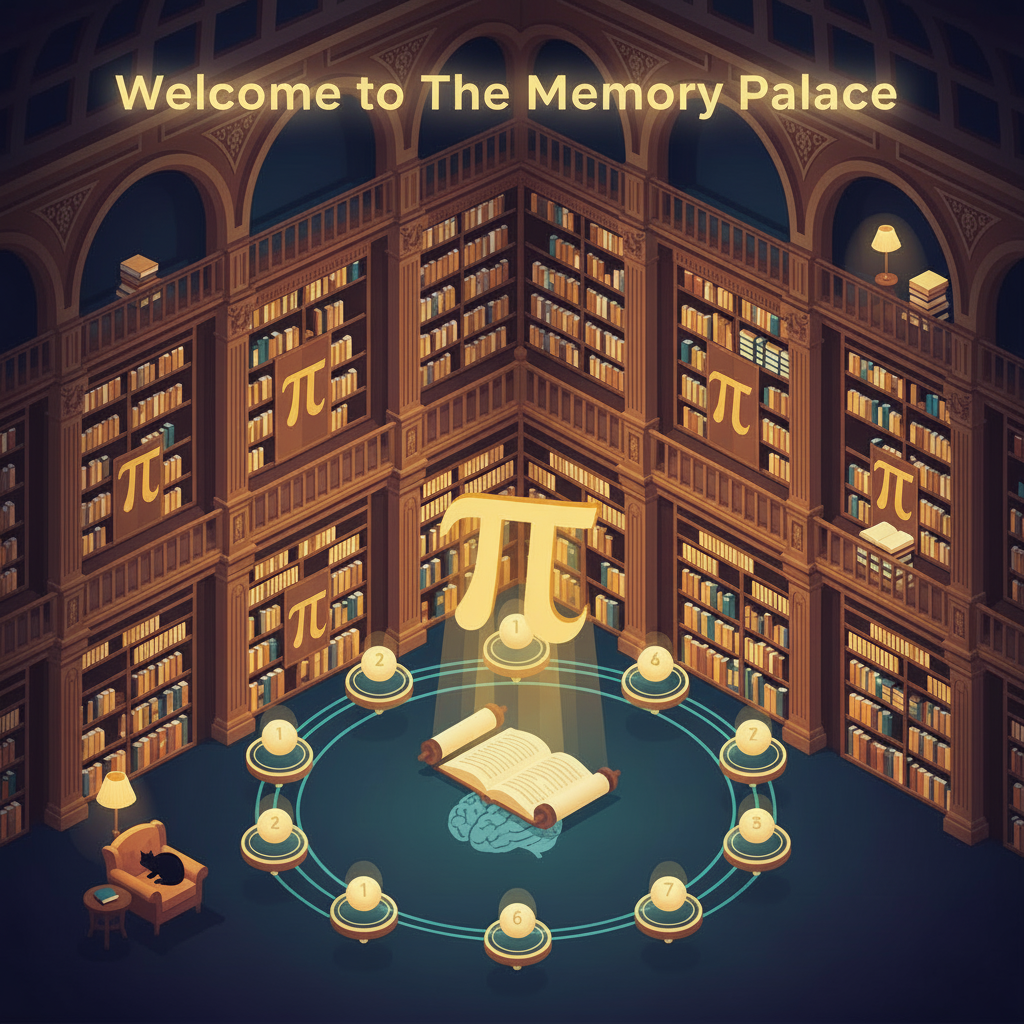
They turn a meaningless digit stream (3‑1‑4‑1‑5…) into images, stories, patterns, or locations in a memory palace. Memory athletes often assign characters, objects, or vivid scenes to groups of digits so they stop being abstract and start being memorable.
Storage
Those encodings live as neural connections; distributed, compressed, and context‑rich. The brain doesn’t store “314159…” as raw text; it stores webs of associations.
Recall
They can “walk” through the structure and recite the digits in order, often under pressure, by mentally revisiting each scene or location in sequence.
Memory athletes who learn tens of thousands of digits rely on mental tricks, not raw storage space. They repurpose the brain’s strength for stories and places to handle abstract digits.
An AI model or a classical algorithm is different:
A pi‑computing program (like y‑cruncher) doesn’t memorize digits; it recomputes them based on formulas and stores chunks externally.
A large language model doesn’t hold trillions of digits internally; it has statistical weights that encode patterns in text, code, and math, but not a literal lookup table of every digit of pi.
In both cases, the system can access huge stretches of pi, but not by “knowing” them in the human sense. It either:
Derives them algorithmically as needed, or
Reads them from external storage once computed or downloaded.
Could AI Store Infinite Digits If We Tried?
Even if you stacked data centers across continents, you’d still run into the same wall: infinity.
To “memorize all of pi,” you’d need infinite memory.
To compute all of pi, you’d need infinite time and energy.
Finite hardware means finite storage. At any snapshot in time, your AI system can only hold some finite prefix of pi: maybe billions, trillions, or even quadrillions of digits in the far future, but never the entire infinite sequence.
What AI can do, however, is store:
The algorithm for generating pi.
The state of a computation that can be resumed.
Indexes into large precomputed digit sets stored in distributed systems.
Think of it like this: a chef doesn’t memorize every possible cake; they memorize recipes and techniques. Given time and ingredients, they can bake what you ask for. AI will always handle pi the same way: through recipes (algorithms), not total memorization.
Why Compute So Many Digits If We Don’t “Need” Them?
From a practical standpoint:
Engineers rarely need more than a few dozen digits of pi for even extremely sensitive calculations. Anything beyond that doesn’t change real‑world results.
So why chase 100 trillion or 300+ trillion digits?
It stress‑tests hardware: storage subsystems, CPUs/GPUs, cooling, error correction, and networking.
It validates algorithms at scale: if a method can handle 300 trillion digits without crashing or drifting, it’s robust.
It pushes boundaries and sparks curiosity, drawing public interest to math, computing, and data science.
That’s exactly the angle you can highlight for learners:
Humans use tools like PracticePi to test their minds.
Researchers use giant pi computations to test their machines.
Both are training, just at very different scales.
Where AI and PracticePi Overlap
For students and teachers, the most valuable takeaway isn’t “AI can’t memorize all of pi,” but what AI can teach us about learning.
AI shows that raw storage capacity and compute power can go way beyond human limits.
Humans show that structured encoding (memory palaces, patterns, rhymes) lets us do a lot with a little.
PracticePi sits in the middle: it gives learners an efficient way to practice digits while experimenting with strategies that echo those used by both memory athletes and algorithm designers.
So, Could AI Ever Memorize All of Pi?
Putting it all together:
Pi has infinitely many non‑repeating digits. That’s built into what it means for pi to be irrational.
Any AI system we can build has finite memory, finite storage, and finite time.
Therefore, no AI can ever “memorize all of pi” in the literal sense.
But:
AI‑driven systems have already helped compute and verify hundreds of trillions of digits, and future records will almost certainly go higher.
AI can learn patterns in how pi is computed, optimize algorithms, estimate error, and manage massive data flows better than humans alone.
AI can’t hold infinity in its head, but it can get us closer to the edge of what’s computable, faster, cheaper, and more reliably than ever.
AI will never memorize all of pi, but it doesn’t need to. What matters is how we use AI to explore the number, understand it better, and push our own human limits along the way.
If a student uses PracticePi to go from 10 digits to 100, they’re doing, on a small scale, exactly what big compute clusters are doing when they go from 100 trillion to 300 trillion: testing boundaries, refining methods, and discovering what’s possible, digit by digit.