Pi Myths and Misconceptions: Clearing Up the Confusion
Have you ever seen Pi in a classroom, heard jokes, or memorized 50 digits to impress someone on Pi Day? Pi has an interesting way of following us around. Most of us remember “3.14” and move on with our lives.
Underneath that little decimal, though, is a number that has picked up a surprising amount of baggage, half‑true stories, shortcuts that turned into “facts,” and misunderstandings that stick around long after the test is over. Let’s walk through some of the biggest misconceptions about pi and straighten them out, gently, one at a time.
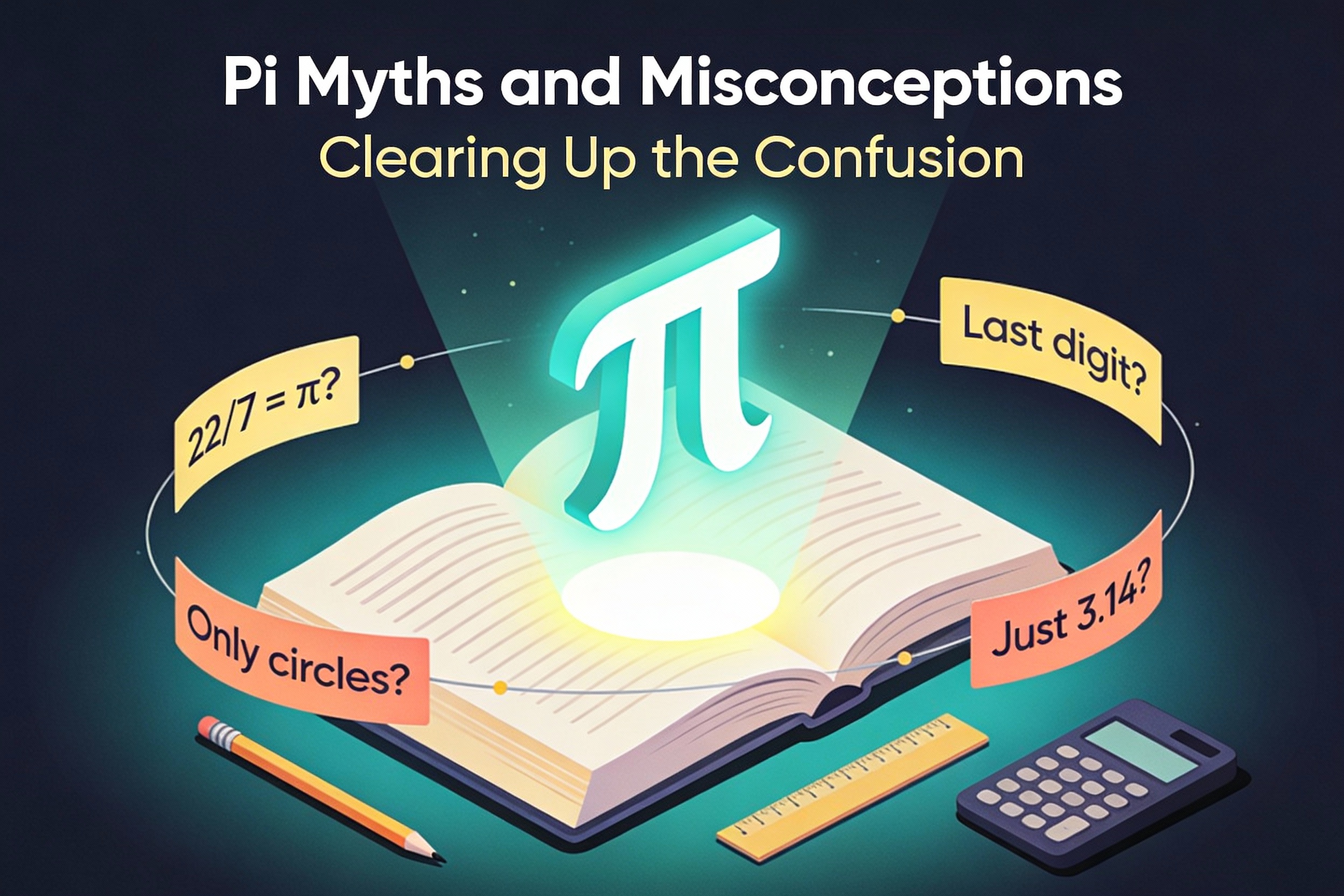
Myth 1: “Pi equals exactly 22/7.”
If you were ever told to “just use 22/7” for pi, you’re in good company. It’s a classic classroom trick: fractions feel friendlier than decimals, and 22/7 gives a nice, clean way to work with circles when you don’t want to keep punching buttons on a calculator.
The trouble comes later, when “this is a handy fraction” quietly morphs into “this is pi.”
It’s not. Pi is defined as the ratio of a circle’s circumference to its diameter. Pick any perfect circle, measure around the edge, divide by the distance across, and you get pi. That number is locked in by geometry itself.
Now compare:
22/7 ≈ 3.142857…
Pi ≈ 3.141592…
Close, but not the same. 22/7 overshoots a little. It’s good enough for rough work and mental math, and it has a rich history, but it will always be an approximation, a really good fake, not the real thing.
So if you still like using 22/7, that’s fine. Just keep in mind what it really is: a well‑behaved stand‑in, not the actual value of pi.
Myth 2: “Someday we’ll find pi’s last digit.”
This one sounds like the plot of a sci‑fi movie: a team of scientists, a giant computer humming in a dark room, and at the end of the process, they finally print out the very last digit of pi. Roll credits.
Reality is much less dramatic and more interesting. Pi doesn’t have a last digit. Pi is what’s called an irrational number. In math language, that means two things:
You can’t write pi as a simple fraction of whole numbers, like 5/7 or 13/20.
Its decimal expansion never ends and does not settle into a repeating pattern.
That “never ends” part kills the dream of a last digit. No matter how many digits we calculate, there’s always another one, and another one after that. You can think of it like walking down a road that keeps stretching out in front of you. You can go farther and farther, but there is no final brick in the path.
We’ve already pushed pi out to trillions of digits. All of those digits are interesting in their own way, but none of them is “the last one,” because there isn’t one.
Myth 3: “Maybe pi’s digits repeat, and we just haven’t gone far enough.”
This myth is the quieter cousin of the “last digit” idea. It usually sounds like, “Sure, we haven’t seen a pattern in pi yet, but maybe it’ll show up later if we calculate enough digits.” It’s a reasonable thought. A lot of things in math do eventually reveal patterns if you look long enough. Pi just isn’t one of them.
When mathematicians proved that pi is irrational, they weren’t just eyeballing the first few digits and guessing. They proved, in a precise way, that pi cannot be written as a fraction of whole numbers. A built‑in consequence of that is its decimal expansion can’t terminate, and it can’t repeat in a fixed pattern, the way rational numbers do.
Compare pi with something like 1/3 or 1/7:
1/3 = 0.3333… (3 repeats forever)
1/7 = 0.142857142857… (the block “142857” repeats.)
If you wrote those decimals long enough, you’d keep seeing the same chunk of digits again and again. That repeating block is the signature of a rational number. Pi doesn’t have a repeating block hiding somewhere down the line. If it did, it wouldn’t be irrational, and we’d have broken a lot of math in the process.
So no, we’re not just “too early” to see the pattern. The point is that there isn’t one, at least not in the simple repeating sense people are imagining.
Myth 4: “Pi is just 3.14, and that’s that.”
On the other side of the spectrum, there’s the super‑casual version: pi is 3.14, full stop. This one usually isn’t spoken out loud as a belief; it just shows up in how people work. Whenever a circle pops up, 3.14 gets tossed into the calculator without a second thought.
The honest truth is that 3.14 is just a very short approximation, like taking a single, slightly blurry snapshot of a movie that runs for hours. Those four characters, “3.14,” cover only a tiny part of the number:
Pi ≈ 3.1415926535…
You don’t need all those digits for most everyday problems. But it’s worth remembering that “3.14” is a choice, not a property of the number. It’s how we decide to round pi for convenience.
You can think of it this way: pi is the full song; 3.14 is a short clip. Sometimes a clip is all you need. Sometimes you want a little more.
Myth 5: “We need more digits of pi for serious science.”
Every few years, there’s a headline: “New record! Pi calculated to X trillion digits.” It’s easy to see those numbers and assume that more digits must be crucial for advanced science and engineering. Why else would people bother? Space agencies, for example, don’t navigate spacecraft using a trillion‑digit pi. They pick a reasonable number of digits, far fewer than you’d think, and that’s enough. At some point, your equipment and measurements are not precise enough to even notice the extra decimal places. Adding more just doesn’t change the answer in a meaningful way.
So why keep calculating? Because it’s a tough challenge and a great test. Computing trillions of digits of pi is like giving a supercomputer a marathon: if it can handle that task, it’s probably reliable for other heavy‑duty jobs too. In other words, more digits of pi are about testing our tools, not about needing those digits to build bridges or send probes to Mars.
Myth 6: “Pi lives only in geometry class.”
For a lot of people, pi lives and dies in one chapter of one math book: Measure a circle, write down C = 2πr and A = πr², do a few problems, then never think about it again.
Pi deserves a little more credit than that.
While circles are where pi is born, the number wanders into many other areas:
In trigonometry, pi shows up when we measure angles in radians and describe functions like sine and cosine. A full turnaround of a circle is 2π radians, and that idea is woven into every graph of those wave‑like curves.
In physics, pi appears in formulas for waves, circular motion, electricity, and quantum mechanics. Whenever something cycles, rotates, or vibrates, pi is usually nearby.
In statistics, the famous bell curve, the normal distribution, has pi literally built into its formula. That curve shows up in everything from test scores to measurement errors.
So yes, pi starts with circles. But it doesn’t stay there. It’s more like a recurring character that pops up whenever the math involves rotation, symmetry, or smooth, repeating motion.
Myth 7: “Pi is random or magical.”
Because the digits of pi seem wild and unpredictable, people sometimes talk about it as if it were this mysterious, chaotic object, almost magical, like it’s hiding secrets about the universe in its decimal expansion.
Pi is certainly fascinating, but it isn’t magic.
It’s a very specific number: the ratio of circumference to diameter for every circle. That definition pins it down completely. If you know the geometry, you know what pi is, even if you never see all the digits.
The digits look random because they don’t repeat and they don’t follow an obvious pattern. That’s enough to make them feel chaotic, but “looks random” is not the same as “is random.” In fact, pi is as fixed and non‑random as a number can be: every digit is determined by its definition, even if some of the deeper questions about how those digits are distributed are still open.
You don’t have to believe pi is magic for it to be wonderful. “Exact number with endlessly complicated digits” is already a pretty good story.
Myth 8: “You have to be a genius to really get pi.”
Pi’s long decimal tail, the fancy symbols, and the deep proofs—these can make it feel like pi lives in a world that’s off‑limits to ordinary people. That feeling alone can scare students away from digging deeper.
The heart of pi, however, is very simple:
Draw a circle.
Measure how far it is around.
Measure how far it is straight across.
Divide the first by the second.
That ratio is pi. That’s it. Everything else—irrational numbers, transcendental proofs, infinite series, and record‑breaking computations—grows out from that basic starting point.
You don’t need to understand every high‑level detail to appreciate pi. Just like you don’t need to be a mechanic to enjoy driving a car, you don’t have to be a mathematician to be curious about this number. Asking “Why does this number show up so often?” is already a very human, very accessible place to start.
Bringing it all together
Pi has collected many stories over the centuries, and not all of them are true. It isn’t exactly 22/7. It doesn’t have a last digit hiding somewhere. It’s more than 3.14, even if that’s all you ever plug into a calculator. We don’t need endless decimals to do real‑world science, and it definitely doesn’t belong only to “math geniuses” or to one chapter of geometry.
What pi really is turns out to be more satisfying than the myths. It’s a simple idea, the constant ratio between “around” and “across” a circle, that unfolds into infinite depth. Its digits never end, its patterns never settle into a loop, yet the number itself is perfectly well-defined and amazingly useful.
Maybe that’s why Pi sticks with people. It starts as a tiny bit of trivia, and then, when you look closer, it becomes a reminder that even the most familiar shapes can hide stories that stretch far beyond what we can write down.