From 3.14 to Infinity: A Short History of Pi”
Circles, ropes, and the first approximations
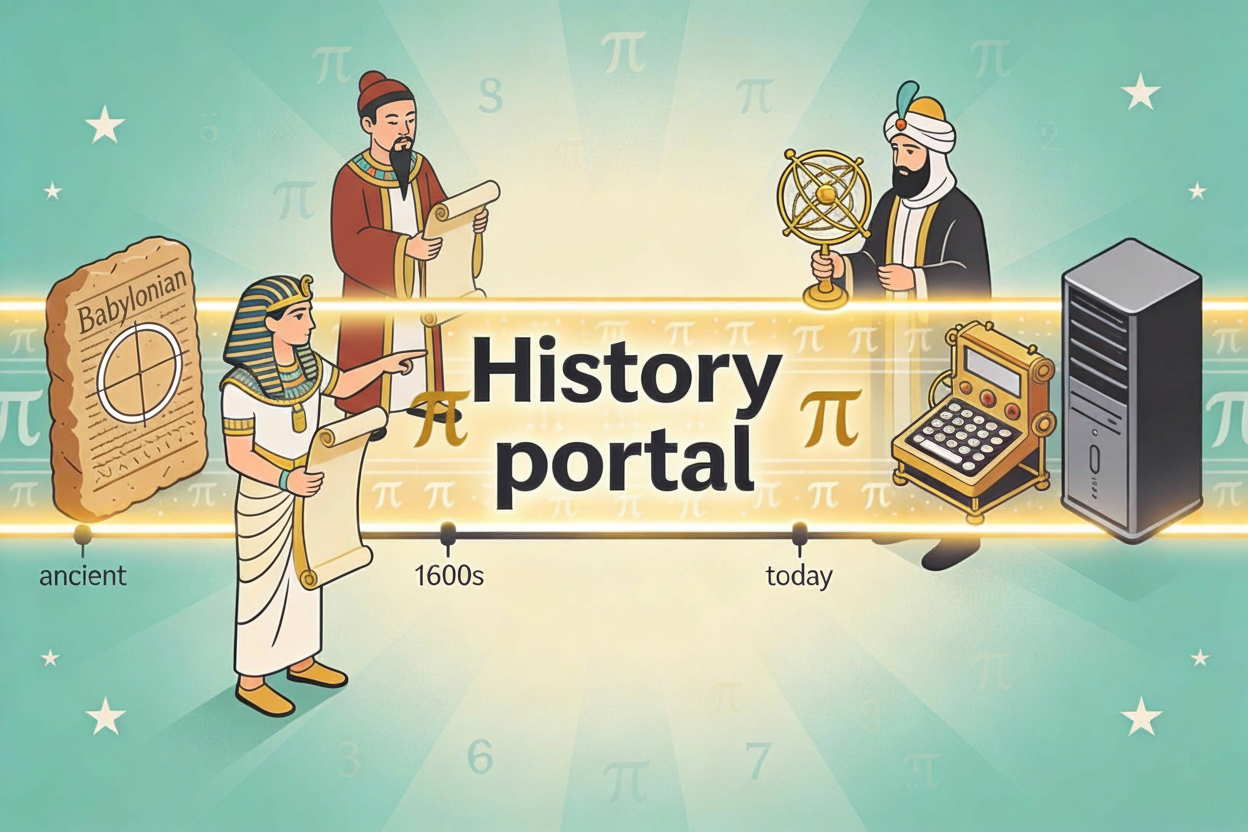
Long before anyone wrote a symbol for π, people were building wells, wheels, pots, and temples. Whenever a circle appeared, some version of “how far around is this?” followed close behind. So you may be wondering, “Who were the first recorded people to introduce variations of pi?” Here they are:
Babylonians (around 1900–1600 BCE) used practical approximations, such as π≈3.125, which appears in clay tablet calculations for circular fields and buildings.
Ancient Egyptians ( around 1650 BCE) used a clever rule in the Rhind Mathematical Papyrus: they effectively treated π as about 3.16 by shrinking the diameter slightly before squaring it to get the area.
These early cultures weren’t trying to prove anything about π; they just needed answers good enough to build things that didn’t collapse. Their “3‑ish” values, though rough, were accurate enough for surveying land and carving stone.
Archimedes and the polygon squeeze
The first truly famous name in the history of π is Archimedes of Syracuse (around 287–212 BCE). He didn’t know the word “irrational,” nor was there a special symbol π, but he understood circles deeply.
Archimedes used a beautiful idea:
Draw a circle.
Fit a regular polygon inside it (say, a hexagon), and another one outside it.
Calculate the perimeters of both polygons.
Increase the number of sides (12, 24, 48, and so on), and repeat.
As polygons gain more sides, their perimeters “squeeze” closer to the true circumference of the circle. Archimedes used a 96‑sided polygon to show that π lay between 223/71 and 22/77, which is about 3.1408<π<3.1429.
For his time, this was astonishingly accurate. The famous fraction 22/7 (still used as a classroom approximation today) arises directly from this work.
Pi Travels across Cultures
After Archimedes, the story spreads worldwide, with each culture carrying the idea forward in its own way. Here are some examples of how he shaped ideas across the world:
In China, mathematician Zu Chongzhi (5th century CE) used polygon methods to produce the fraction 355/113, which approximates π to six decimal places: 3.1415929… For everyday use before calculators, this was remarkably sharp.
In India, mathematicians working in the Kerala school (around the 14th–16th centuries) developed early versions of infinite series that could generate digits of π, ideas that look surprisingly modern to today’s eyes.
During the Islamic Golden Age, scholars translated, preserved, and built on Greek and Indian work, improving approximations for astronomy and engineering.
Even without phones or laptops, patience and clever geometry slowly pushed π toward increasingly accurate values.
The symbol “π” and the age of formulas
For centuries, people talked about the ratio of circumference to diameter, but there was no universal symbol for it. That changed in the early 18th century.
In 1706, Welsh mathematician William Jones used the Greek letter π to denote this circle ratio, likely chosen as an abbreviation for “perimeter.”
A few decades later, Leonhard Euler, one of history’s greatest mathematicians, adopted the symbol. When Euler uses a symbol, the math world tends to follow, and π sticks.
One widely known example is the Leibniz formula: π divided by 4 equals one minus one third plus one fifth minus one seventh, and so on. This means π/4 = 1 − 1/3 + 1/5 − 1/7 + ... The terms alternate in sign, and each denominator increases by two.⋯
π/4 = 1- 1/3 +1/5- 1/7 + ...
This particular series converges painfully slowly, but it opened the door to a new way of calculating π: not by drawing more sides on polygons, but by summing terms in a formula. Other mathematicians, including Euler, found faster series and relationships, relying heavily on trigonometry and calculus to improve accuracy.
By the 19th century, people had calculated hundreds of digits of π by hand, pages and pages of careful arithmetic.
Proving pi is irrational (and more)
For a long time, π was treated as a mysterious constant that just “showed up” whenever circles were involved. In the 18th and 19th centuries, mathematicians started asking harder questions: What kind of number is this, exactly?
In 1768, Johann Lambert proved that π is irrational, meaning it cannot be written as a simple fraction of two integers, and its decimal expansion never terminates or repeats.
Later, in 1882, Ferdinand von Lindemann went even further, showing that π is transcendental, meaning it is not the root of any polynomial equation with integer coefficients.
That last result had a famous side effect: it proved that you cannot “square the circle” with only a compass and straightedge, that is, you cannot construct a square with exactly the same area as a given circle using just those classical tools.
At this point, π was no longer just a handy constant. It had become central to deep questions about numbers.
When machines entered the game
For most of history, calculating π meant sitting with paper, ink, and endurance. That balance shifted with the arrival of mechanical and electronic computing.
In the late 19th and early 20th centuries, people used mechanical calculators (crank‑driven machines) to push π beyond what was realistic by hand alone.
In 1949, one of the earliest electronic computers, ENIAC, was used to compute π to 2,037 decimal places, taking about 70 hours of machine time!
This marked a turning point! Once computers became part of the story, the record for the most digits of π started to grow much faster, driven by both better algorithms and more powerful hardware.
Modern records: trillions of digits and new algorithms
Today, calculating new digits of π is more about stress-testing technology than “needing” them. It’s a way to check that supercomputers and storage systems can handle enormous computations without error.
Two big ingredients drive modern record‑setting:
Efficient formulas: Algorithms like the Gauss–Legendre method and later the Chudnovsky formula converge incredibly quickly, producing many digits of π with each step.
Massive computing power: Clusters of processors, cloud infrastructure, and optimized code enable these calculations to run for days or weeks.
Recent records have pushed π into the realm of trillions of digits. For perspective, even NASA doesn’t need nearly that many for navigation; a few dozen suffice for most applications.
The extra digits are more about curiosity and computing bragging rights than engineering need, but they show how far technology has come from clay tablets and hand‑drawn polygons.
Why is this history worth sharing with students?
On the surface, π is “just” a number, but its history gives students more to chew on than a random decimal string:
It shows how different cultures tackled the same problem with the tools they had.
It highlights a few individuals, Archimedes, Zu Chongzhi, Euler, Lambert, and Lindemann, who saw deeper patterns and were willing to chase them.
It illustrates how new technology doesn’t replace math; it amplifies it. Better formulas and better machines work together.
Most of all, the journey from 3‑ish approximations to trillions of digits reminds us that math is a human story. People curious about circles, building better tools, and asking “what if we go a little further?” slowly turned a simple ratio into one of the world’s most famous numbers.