Famous People Obsessed with Pi (Yes, Really)
Pi has a way of getting under people’s skin. For most of us, it’s a hazy memory of 3.14 on a classroom poster. For a surprisingly large group of others, scientists, students, celebrities, and full‑on memory athletes, it becomes a lifelong fascination, a world‑record goal, or even a personal brand.
If you’re building a Pi‑practice habit with something like PracticePi, these stories are a powerful hook. They show students (and adults) that loving pi isn’t just “a math teacher thing”, it’s something real people have turned into art, records, and weirdly specific life goals.
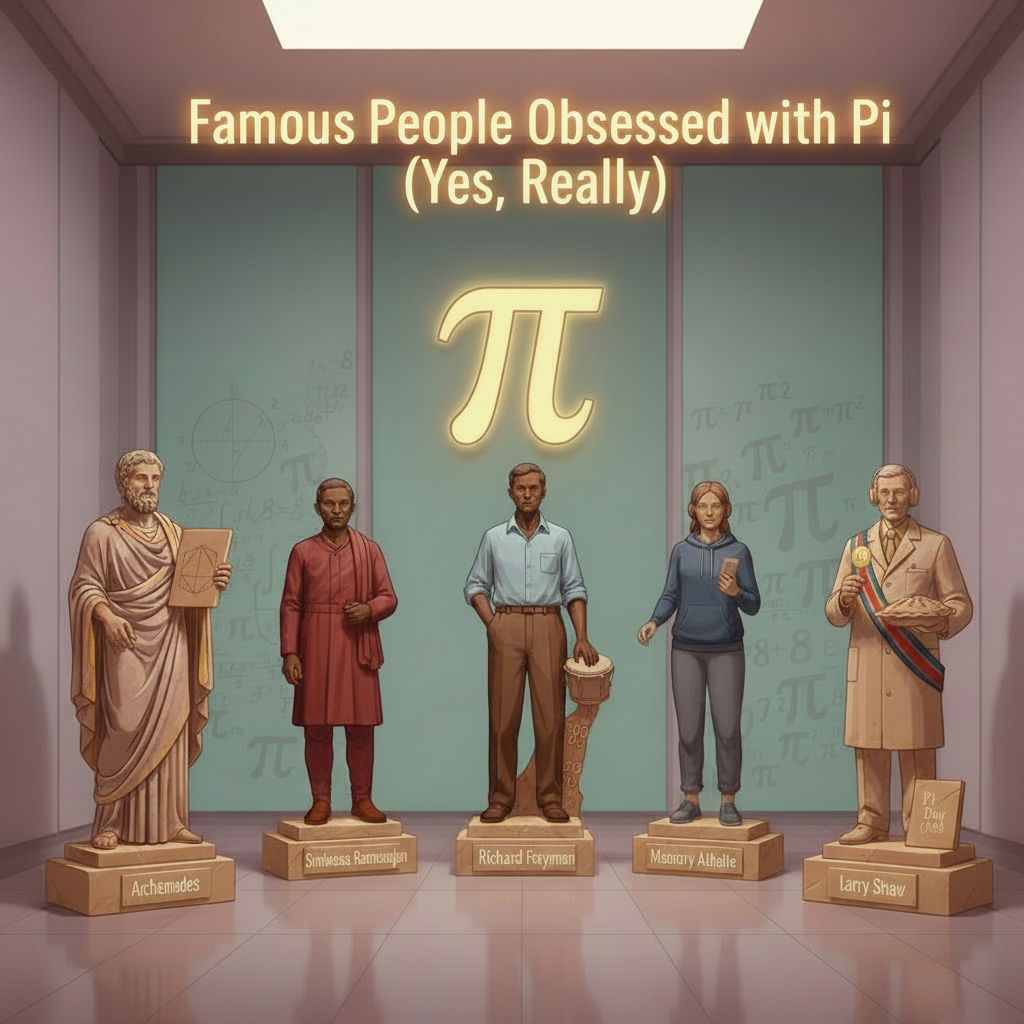
Here are some of the most interesting people, past and present, who have been a little (or a lot) obsessed with pi.
Archimedes: The Original Pi Perfectionist
Long before Pi Day shirts and digit apps, Archimedes of Syracuse was grinding away at pi with nothing but geometry and grit. Around 250 BCE, he used polygons to estimate pi between two values and found it to be about 3.1418, an incredibly accurate estimate for his time.
He inscribed and circumscribed polygons around a circle, increasing the number of sides to get tighter bounds.
This process served as a template for approximating pi with arbitrary accuracy for centuries.
By modern standards, Archimedes would absolutely be “that person” who spends nights tweaking approximations just to shave off a tiny error. His obsession gave us one of the earliest systematic methods for chasing more digits.
PracticePi angle:
Use Archimedes as your historical “why” before you introduce pi practice: humans have been trying to nail this number down for over 2,000 years; you’re just doing it with a phone instead of a wax tablet.
Srinivasa Ramanujan: Pi Formulas from Nowhere
Fast‑forward to the early 1900s, and you hit another pi‑driven mind: Srinivasa Ramanujan. Working largely in isolation in India, he developed shockingly fast‑converging formulas for pi that still amaze mathematicians.
One of his famous series helped lay the groundwork for modern algorithms that compute pi to billions and trillions of digits.
Even today, mathematicians admit they don’t fully understand how he saw some of these formulas; his notebooks are full of pi results with little or no proof attached.
Ramanujan’s work is a reminder that pi doesn’t just attract careful calculators; it pulls in raw intuition and creativity as well.
PracticePi angle:
When students feel like “real math” is out of their league, use Ramanujan’s story to show how far raw curiosity and persistence can go, even if you’re “just” chasing your next 10 digits.
Richard Feynman: The Physicist Who Wanted to Troll Pi
Physicist Richard Feynman wasn’t famous for memorizing pi, but he did have a very Feynman‑style goal involving it. He once said he wanted to memorize enough digits to reach the spot where the sequence goes “999999” (the so‑called Feynman Point) and then end his recitation with “…nine nine nine nine nine nine and so on.”
The Feynman Point appears at the 762nd decimal place, where six 9s appear in a row.
Ending with “and so on” would jokingly imply that pi turns into an infinite run of 9s, which would make it a rational number, something every mathematician knows is false.
It’s classic Feynman: deep understanding plus a nerdy sense of humor.
PracticePi angle:
Turn this into a challenge:
“Can anyone get far enough in PracticePi to reach the Feynman Point?” Even if they don’t, they’ll remember that strange island of six 9s.
Memory Athletes: 70,000 Digits and Counting
Then there are the people whose pi obsession is plain and simple: memorize as many digits as humanly possible.
Some highlights:
According to pi‑fact compilations, Rajveer Meena set a Guinness World Record in 2015 by reciting 70,000 decimal places of pi while blindfolded. It took him about 10 hours.
Articles on pi recitation note feats like Chao Lu reciting 67,890 digits, taking more than 24 hours with only very brief pauses allowed.
U.S. news outlets have profiled record‑holders like Mark Umile, who recited over 15,000 digits and described using hours of writing, recording, and replay to lock them in.
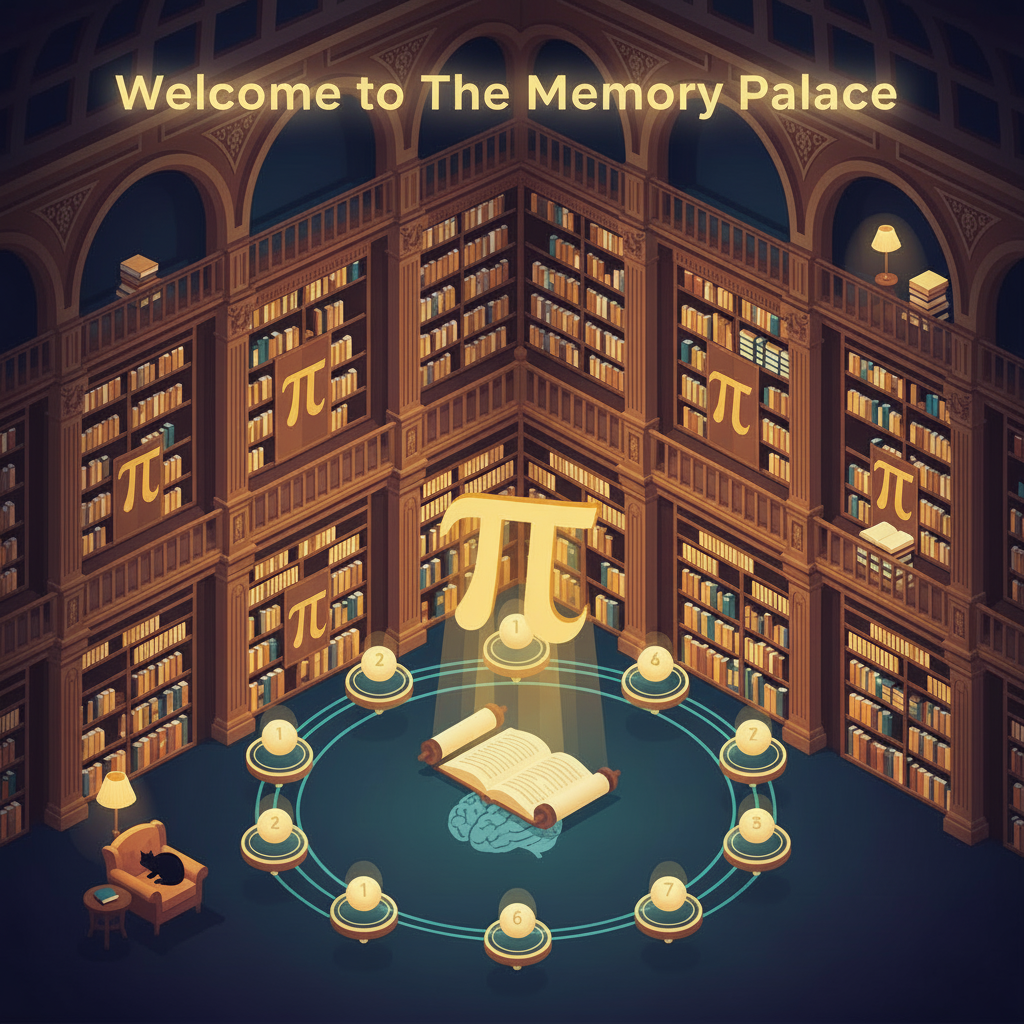
These “piphilologists” turn pi into an extreme sport. They rely on advanced memory techniques, image association, memory palaces, and sound patterns to transform bare digits into something their brains can actually hold.
PracticePi angle:
You don’t need 70,000 digits to benefit from pi practice. But telling students “The world record is 70,000—how far do you want to go?” instantly makes a 50‑digit goal feel reachable and exciting.
Larry Shaw: The “Prince of Pi” Who Built a Holiday
If you enjoy Pi Day every March 14, you can thank Larry Shaw, a physicist at San Francisco’s Exploratorium, who is often called the “Prince of Pi.”
In 1988, Shaw organized the first official Pi Day at the Exploratorium, choosing March 14 (3/14) to match the first digits of pi.
The celebration included circular parades and plenty of pie, and the tradition spread so widely that the U.S. House of Representatives recognized March 14 as National Pi Day in 2009.
Shaw turned a personal enthusiasm for pi into a global math holiday. That’s obsession turned into culture.
PracticePi angle:
Frame PracticePi as a way to give Pi Day “founder energy” to your classroom or family: you’re not just memorizing; you’re building your own tradition on top of Shaw’s.
Celebrities and Social Media: Pi Day as a Flex
Not all Pi fans are mathematicians. Pi Day has become Instagram- and TikTok‑friendly, drawing in celebrities and influencers who use it as an excuse to post pies, pizza, and math puns.
Lifestyle articles and local news pieces have highlighted how big names: Oprah, Jennifer Lopez, Chrissy Teigen, and others, share Pi Day pie posts or themed content with their followers.
Viral roundups show everyday people and creators going all‑in on Pi Day costumes, pie bakes, and classroom events, turning 3/14 into a mini‑holiday for food and nerd pride.
These aren’t deep dives into number theory, but they do something important: they make pi visible. When kids see Pi Day trending alongside other big cultural moments, it stops feeling like an obscure inside joke.
PracticePi angle:
Invite students to join the “Pi Day flex”:
Post a Pi Day photo plus a caption like “Up to 25 digits in PracticePi.”
Turn their memorization progress into something they’re proud to share, just like a gym PR or a game achievement.
Why Pi Attracts This Kind of Obsession
Put all these people together—ancient geometers, intuitive geniuses, physicists, memory athletes, festival founders, and celebrities—and a pattern emerges:
Pi is simple to define (circumference divided by diameter), but deeply complex under the hood.
It’s everywhere: circles, waves, orbits, random‑looking digits, and even pop culture cameos (from Star Trek to novels like Carl Sagan’s Contact, where he imagines a hidden message buried in pi’s digits).
It offers a sense of infinity you can actually touch: every new digit is a tiny step into something that never ends.
If you’ve ever felt a little tug to learn “just one more digit,” you’re in good company.
You’re following in the footsteps of some of the most interesting minds in history,and with PracticePi, you can explore that fascination in a focused, healthy, and surprisingly fun way.