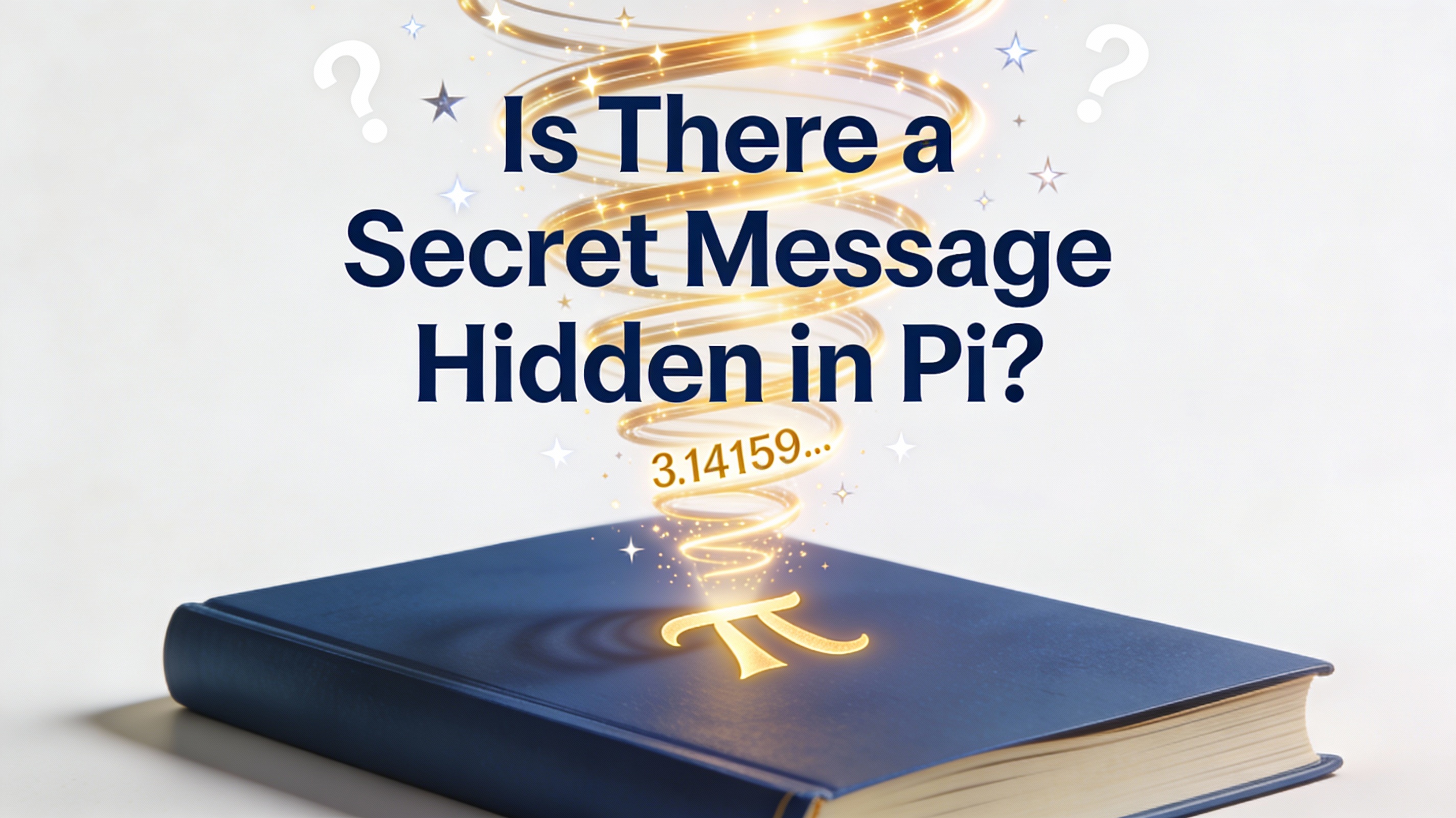
Is There a Secret Message Hidden in Pi?
Pi’s digits feel like the perfect hiding place for a secret message. It goes on forever, they look random, and nobody has ever written them all down. If any number was going to whisper something mysterious about the universe, or about you, it would be this one, right?
That question is exactly why people keep asking: Is there a secret message hidden in pi? The honest answer is both less magical and more interesting than it sounds.
Why Pi Feels Like a Cosmic Code
Start with what makes pi special. Pi is defined as the ratio of a circle’s circumference to its diameter. Take any perfect circle, measure around and across, and divide: you get pi, about 3.14159… and then digits that keep going without end. Mathematicians proved long ago that pi is irrational, meaning its decimal expansion never terminates and never repeats in a simple pattern.
That endless, patternless look gives pi its “cosmic code” vibe:
There’s no visible structure your brain can latch onto.
The digits just keep coming, like static that might secretly be music if you could decode it.
It’s no wonder people wonder: if the digits really go on forever, could they hide birthdays, phone numbers, names, or even full sentences encoded somehow?
What We Actually Know About Pi’s Digits
Here’s where things get subtle. Pi’s digits look random, and they’ve passed a huge number of statistical tests for randomness. That means if you chop up pi into chunks and look at the digits:
Each digit (0–9) appears roughly as often as any other in the parts we’ve checked.
Short sequences, like “14” or “159,” appear with frequencies close to what you’d expect from a random process.
But there’s an important catch: pi is not actually random. Every single digit is determined by the geometry of circles and the formulas we use to compute it. There’s no dice being rolled at each step. Pi is fixed; our ability to calculate it is what improves.
Mathematicians also discuss a concept called a normal number. A number is normal (in base 10) if every possible finite sequence of digits appears in its decimal expansion, and appears with the expected long‑term frequency. If pi is normal, then:
Your birthday is in there.
Your phone number is in there.
Every pixel row of every image you’ve ever seen is somewhere in there.
That sounds like “secret message” territory, but here’s the key: it would be everything, not a targeted message. And as of now, nobody has actually proved that pi is normal. It’s a very strong suspicion, supported by substantial numerical evidence, but it remains unproven.
Found Patterns vs. Real Messages
People have already found some eye‑catching patterns in the known digits of pi. For example:
A run of six 9s in a row appears starting at the 762nd decimal place, famously nicknamed the “Feynman point.”
The sequence 0123456789 appears later on, and other quirky runs pop up if you look far enough.
These discoveries spark headlines and myths. But here’s the crucial distinction:
Patterns in a long sequence are expected, even in genuinely random data. If you flip a coin enough times, you’ll see long streaks of heads or tails.
Messages imply intent: someone chose those digits to say something to you.
Pi’s digits are generated by fixed mathematical rules. Any “word” or “image” you find is more like seeing a familiar shape in clouds. It’s fun, it can be meaningful to you, but the clouds didn’t do it on purpose.
If pi is normal, then every possible “message” appears infinitely many times, but so does every possible piece of nonsense. The signal‑vs‑noise line disappears.
Could Someone Encode a Secret Message in Pi?
This is where things get philosophical.
If you want to hide a message in digits that look like pi, there are easy ways to fake it. You could:
Generate a block of genuine pi digits.
Choose a position far out.
Substitute your secret, carefully encoded chunk there.
Publish that altered “pi” somewhere as a novelty.
To anyone not checking carefully, it’s just “more pi.” To you, it’s a message.
But that’s not really a secret message inside actual pi, it’s a message inside something pretending to be pi. True pi is unforgiving: the second decimal place is always 4, the millionth digit is always whatever math says it is, no edits allowed.
So could the universe itself have encoded a message there? That’s where speculation runs ahead of evidence. Our current understanding says pi’s value falls straight out of the structure of Euclidean geometry and the analytic formulas we use. There’s no space there for a “choice” or a deliberate payload.
Why People Love the Idea Anyway
Even knowing all this, the idea of a hidden message in pi refuses to die, and that tells you something about us:
We’re wired to look for patterns because recognizing patterns used to mean survival.
We like to believe there’s meaning behind the complexity we see.
Pi is one of the rare places where infinite complexity and simple definition collide.
That’s part of what makes pi such a powerful tool for teaching and storytelling. You can stand in front of a screen of digits and ask:
“What do you think might be hiding in here?”
“What would it mean if every possible pattern really exists inside this one number?”
“How does that change the way you think about information, randomness, or even stories?”
Those questions are more valuable than any single “hidden sentence” could ever be.
How PracticePi Fits into the Mystery
If you’re running PracticePi, you’re perfectly positioned to ride this curiosity wave in a fun, honest way.
You can:
Let students search for their birthday or favorite number sequence in the known digits and see where it first appears.
Use that as a launchpad to explain irrational numbers and the idea of normality—at a level that fits their age.
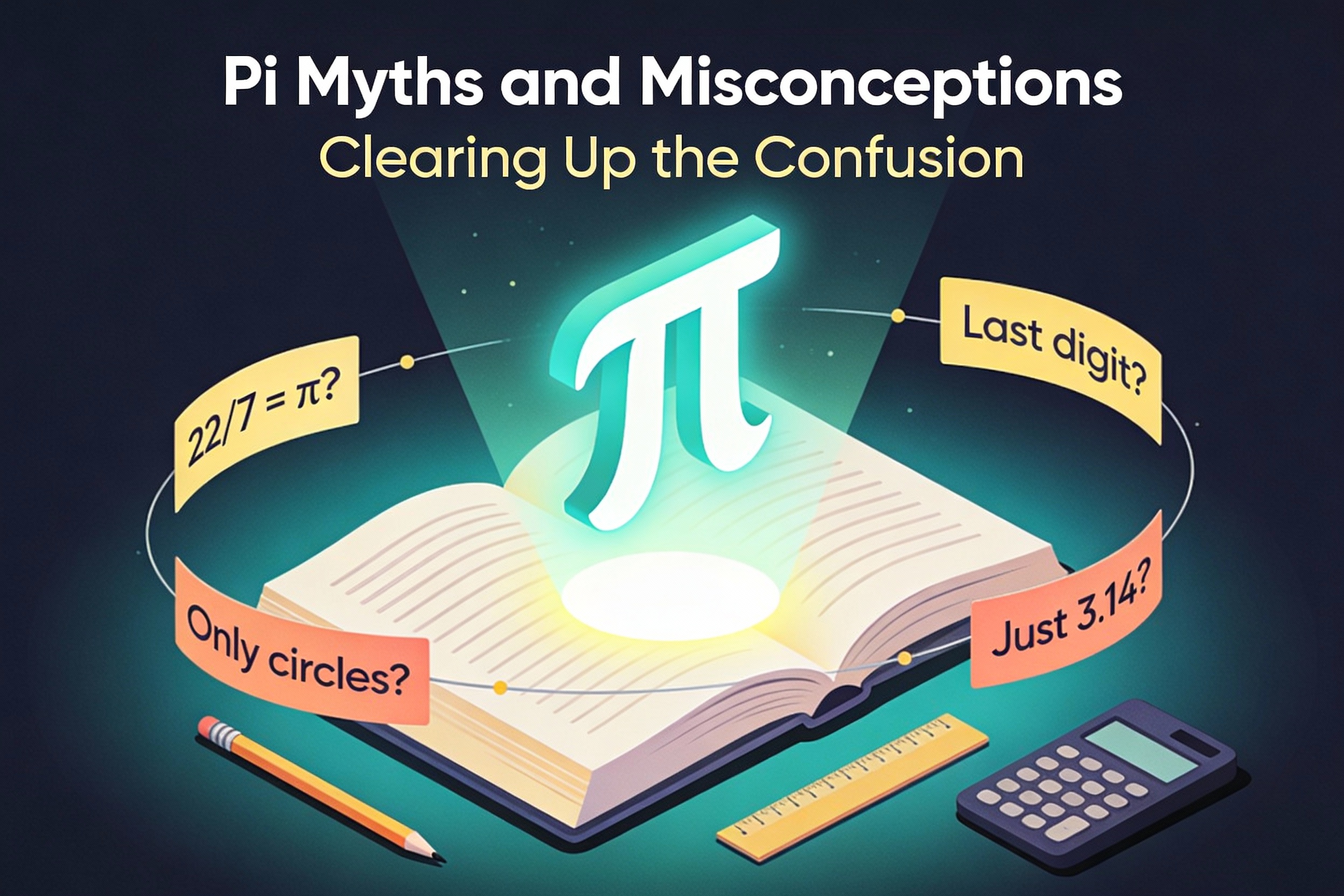
Make a “Pi or Lie?” mini‑quiz about common myths:
“Pi has a last digit.” (Lie)
“We’ve found every digit of pi that exists.” (Lie)
“Pi’s digits go on forever with no repeating pattern.” (Pi)
And while they’re exploring, PracticePi quietly does what it does best: helping them remember more digits, spot small patterns, and feel the texture of the number themselves instead of just hearing about it.
When a learner has personally wrestled with 50 digits, 100 digits, or more, the question “Is there a secret message in here?” hits differently. It feels closer. More earned.
The Most Honest Answer
So, is there a secret message hidden in pi?
If by “secret message” you mean a phrase carefully planted there for us to discover, everything we know about math says no.
If you mean “Does pi contain surprising patterns, coincidences, and possibly every finite string of digits if it’s normal?” then yes, in a sense, but that’s not secret, and it’s not intentional. It’s a by‑product of how infinite, pattern‑rich sequences work.
Maybe the most meaningful “message” pi carries isn’t written in its digits at all. It’s this:
A simple idea, a circle’s around‑to‑across ratio, can unfold into endless depth.
When someone opens PracticePi and starts walking along that endless string of digits, they’re not decoding a cosmic Easter egg. They’re touching a tiny, concrete piece of how our universe is wired.
And that, in its own way, is a lot better than a hidden sentence.