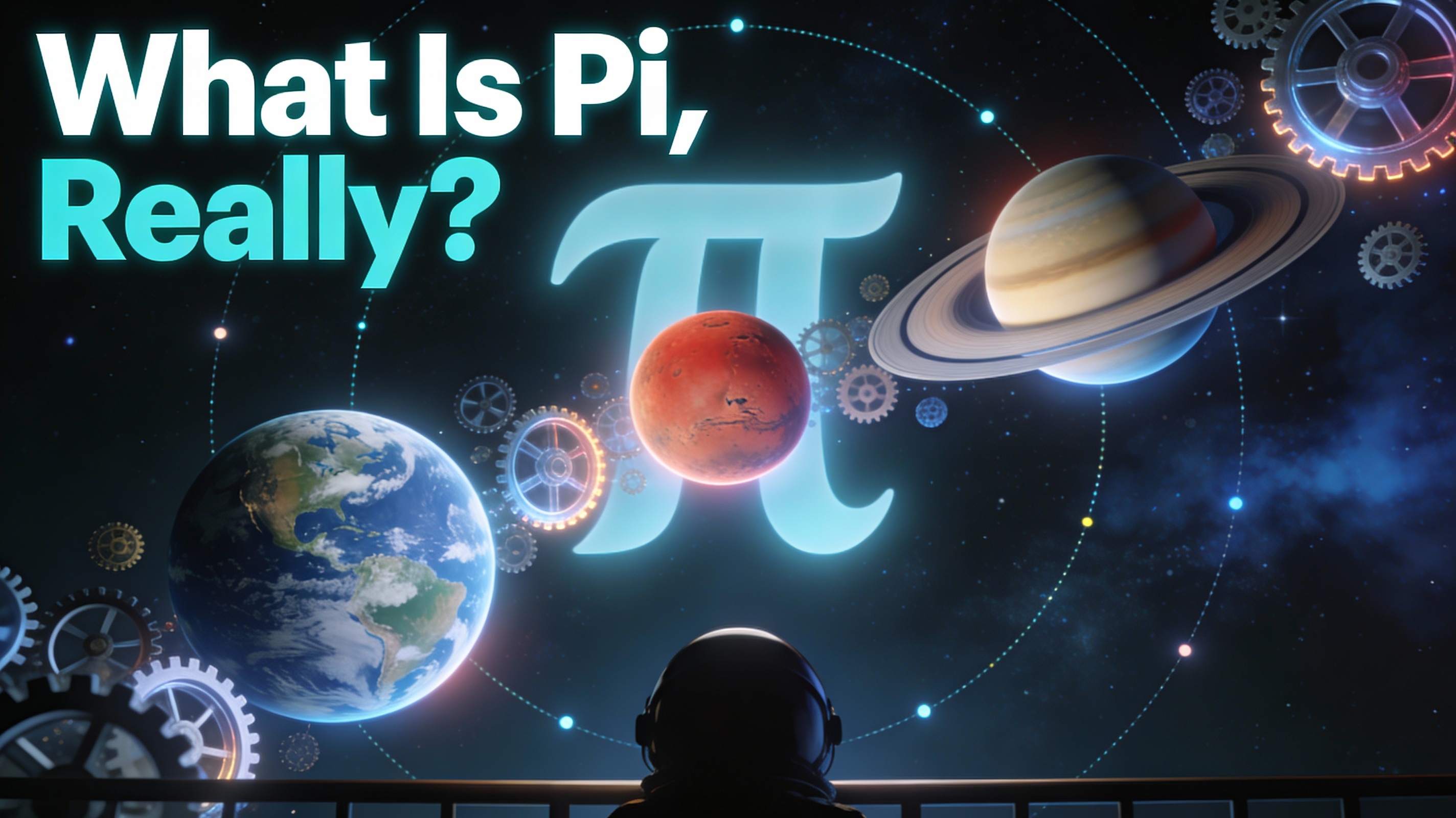
What Is Pi, Really?
Pi has a strange reputation: everyone knows it as “3.14,” but very few people can say what it actually is or why it keeps showing up in so many formulas. This post breaks down pi in plain language, with visuals you can picture in your head and just enough math to feel powerful, not overwhelming.
Pi is the circle’s “conversion factor.”
The quickest way to understand pi is to see it as a conversion between a circle’s size and its boundary.
Take any perfect circle.
Measure all the way around its edge. That distance is called the circumference.
Measure straight across the widest part of the circle. That distance is the diameter.
When you divide the circumference by the diameter, you always get the same number, no matter how big or small the circle is. That number is pi:
π=circumference/diameter
Stretch the circle to the size of a hula hoop, shrink it down to a coin, or imagine a planet‑sized circle in space; the ratio stays the same. Pi is the “scale‑proof” link between the width of a circle and how far you travel if you walk around it once.
A mental picture: a string and a wheel
Imagine a bicycle wheel lying flat on the ground.
Wrap a piece of string tightly around the wheel’s outer edge.
Carefully cut the string and straighten it out into a line.
Now lay that line across the wheel, from one side to the other (the diameter), as many times as it will fit.
You’ll notice the line fits a bit more than three times across the wheel’s diameter, with a little extra piece of string left over. That “three times and a bit” is pi:
About 3 whole diameters
Plus 0.14 of another diameter (and then more, if you could keep measuring forever)
Mathematically, that’s why this formula works:
C=πd
Here, C is the circumference, and D is the diameter. It says, “To get the distance around a circle, take its diameter and multiply by pi.”
If you prefer radius instead of diameter (halfway across the circle), the relationship becomes:
C=2πr
where R is the radius. These two equations are just different ways of saying the same thing, depending on which measurement is easier to work with.
Pi as area: how “much circle” you have
The boundary of a circle is one thing; how much space it covers is another. Pi appears there, too.
If you know the radius of a circle, you can find its area with:
A=πr2
Here’s an intuitive way to picture it:
The radius tells you how far the circle reaches from the center.
Squaring the radius (r2) gives you something like the “base” size.
Multiplying by pi adjusts that base to match the actual shape of a circle.
In other words, “radius squared” by itself does not give you the exact amount of space inside. Pi is the correcting factor that turns “radius squared” into true circular area.
Circles everywhere: wheels, ripples, and orbits
Pi shows up constantly because circles do, sometimes in obvious ways, sometimes in hidden ways.
Wheels and gears
Any time something spins, pi is lurking in the background. Think of:
Car tires and bike wheels
Gears in a machine
A record or a spinning disk
Every full turn of a wheel moves the vehicle forward by exactly one circumference. Since the circumference is 2πr, each rotation moves the wheel’s center by 2πr units. Double the radius, and you double that distance. Even if you never write down the formula, the physics of motion is quietly using pi.
Ripples in water
Drop a stone into a calm pond, and you’ll see circular ripples spreading outward. Each ring is a growing circle:
The distance around each ring is a circumference.
The space inside each ring is an area.
As the radius expands, both the circumference and the area depend on pi. If you were to model how quickly that ripple grows in size, you’d end up relying on those same formulas.
Orbits in space
Planets and moons don’t orbit in perfect circles, but circles are a close first approximation. If you imagine a nearly circular orbit, then:
The path length for one trip around the star or planet is like a huge circumference.
That length is again connected to the radius by 2πr.
Astronomers use more advanced math, but at the core, the idea that “distance around” is tied to radius through pi remains.
Why pi appears beyond circles
At this point, it might seem like pi is just a “circle number,” but it goes deeper.
Many physical systems can be described using waves: sound, light, vibrations, alternating current, and so on. Waves often repeat in cycles, and when problems involve cycles, angles, or rotation, circular ideas sneak in, whether or not you see an actual circle. Consider a simple wave that repeats at regular intervals. To fully describe one cycle of that wave, you can think of moving around a circle: starting at one point, going all the way around, and coming back. The mathematics of these cycles uses angles measured in radians, and radians are directly defined using pi:
A full circle is 2π radians.
Half a circle is π radians.
A quarter circle is π/2 radians.
Even though you may be looking at a squiggly wave on a screen instead of a drawn circle, the math underneath is built on circular motion, and pi comes along for the ride.
Gentle equations that keep showing up
Here are a few non‑intimidating equations where pi plays a starring role:
Circumference of a circle:
C=2πr
Area of a circle:
A=πr2
Angle relationships in radians (full circle, half circle, quarter circle):
2π, π, π/2
These equations are not just classroom trivia. They appear in calculations for:
Designing wheels and gears
Planning circular tracks or round rooms
Modeling waves, rotations, and periodic motion
Learning these few relationships goes a long way toward understanding why pi refuses to stay inside the geometry chapter of a textbook.
Bringing it all together
Pi is not just “3.14.” It is the constant ratio between a circle's width and its circumference, and that single idea creates a thread connecting geometry, physics, engineering, and even the way sound and light behave. Whenever you encounter rotation, cycles, or circular shapes, wheels on the road, ripples on water, orbits in space, pi is quietly in the background, doing the same job every time.
That consistency is what makes pi so powerful for students to study: once you truly understand what pi represents, dozens of formulas stop feeling like separate facts to memorize and start feeling like natural consequences of one simple idea.