Write a Haiku Using the First 5 Digits of Pi
Most people meet pi in a pretty unpoetic way: on a worksheet, next to a circle, with a reminder that it’s “about 3.14.” Useful, sure, but not exactly inspiring.
What if, instead of just memorizing those digits, you could play with them? Turn them into rhythm, imagery, and something you might actually want to share with a friend? That’s where haiku comes in, and where your practice with the first five digits of pi, 3.1415, suddenly becomes more fun than flashcards.
This post walks through a simple, creative activity: writing pi‑themed haiku shaped by those digits. You’ll see example poems, get step‑by‑step instructions, and learn how to fold everything into a quick PracticePi session so learners remember the digits almost by accident.
Why Pi and Haiku Actually Work Well Together
At first glance, pi and poetry seem like opposites. Pi is infinite, precise, and unforgiving: a never‑ending string of digits tied to the geometry of circles. Haiku, on the other hand, are small, emotional, and vague in all the right ways.
Look a little closer, though, and they have something huge in common: structure.
Pi has rules: it starts with 3.1415… and those digits appear in a very specific order.
Haiku have rules: traditionally, three lines with a 5–7–5 syllable pattern, often tied to nature or a moment in time.
When you use the structure of one (pi’s digits) to shape the structure of the other (a poem), you get a mental “hook.” The rhythm of the poem becomes a way to remember the digits, and the digits become a way to remember the poem. That’s how memory works best, through connections, not isolation.
If you’re using PracticePi, this gives you a bonus angle: you’re not just drilling; you’re creating. The app covers the practice. The haiku activity covers the meaning, the feeling, and the fun.
Using 3.1415 as a Poem Template
Let’s start with the digits themselves: 3.1415.
There are a bunch of ways to turn those numbers into a poem pattern, but two of the easiest for all ages are:
A 3–5–6 haiku (three lines)
A 3–1–4–1–5 “stacked” micro‑poem (five lines)
Option 1: 3–5–6 “Pi Haiku”
Here, you bend the classic 5–7–5 haiku pattern to sneak in pi:
Line 1: 3 syllables
Line 2: 1 + 4 = 5 syllables
Line 3: 1 + 5 = 6 syllables
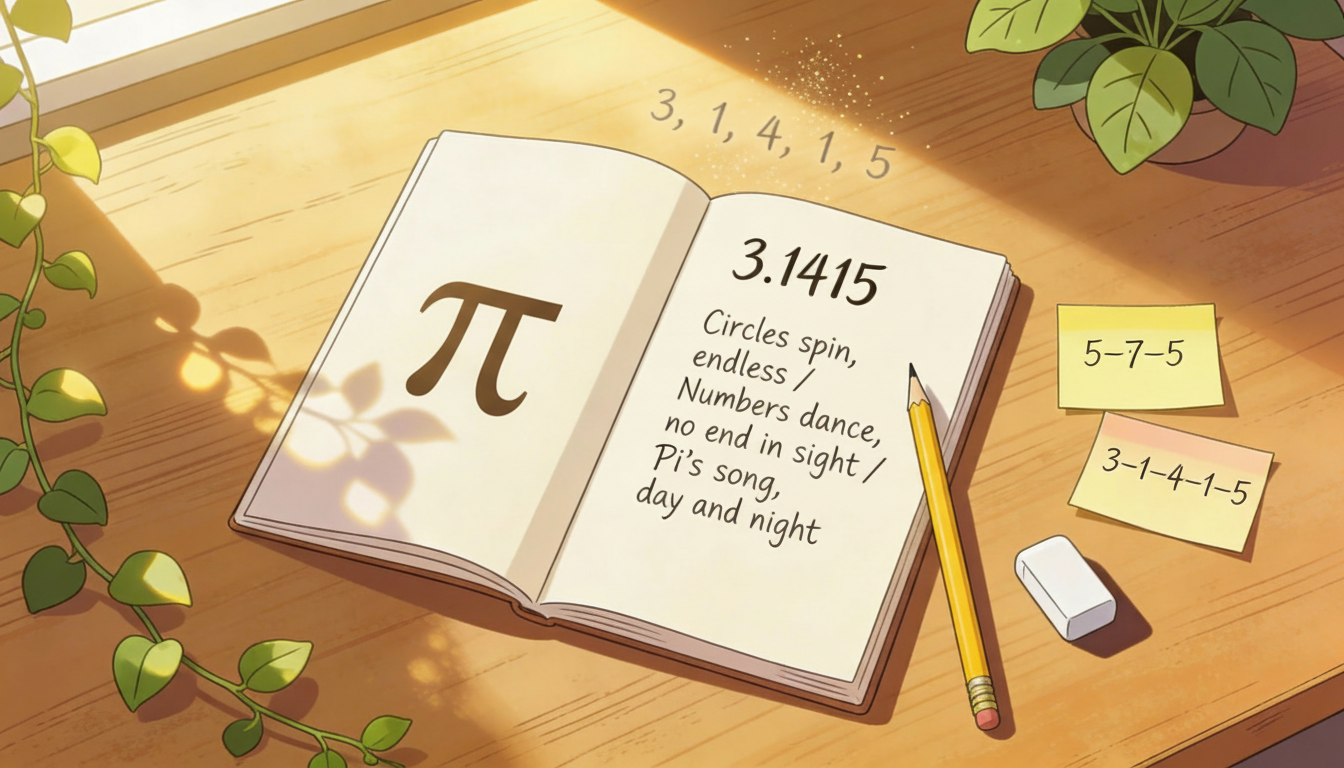
So your poem follows a 3–5–6 syllable pattern. It’s not perfectly traditional, but that’s okay, your “rule” is that the rhythm respects the first five digits of pi.
For example:
Silent circle
Endless digits dance
Hiding in each turn
Check the syllables:
Silent circle → 3
Endless digits dance → 5
Hiding in each turn → 6
Once students know the secret, they never forget the sequence 3–1–4–1–5 that gave them 3–5–6.
Option 2: 3–1–4–1–5 “Stacked Pi Poem”
If you want something more playful and obvious, give each digit its own line:
Line 1: 3 syllables
Line 2: 1 syllable
Line 3: 4 syllables
Line 4: 1 syllable
Line 5: 5 syllables
Now you can point right at the pattern: 3, 1, 4, 1, 5. It’s like building a staircase out of syllables.
Example:
Tiny ring spins
Pi
Circles hide secrets
So
We keep counting on
Syllables: 3 / 1 / 4 / 1 / 5. The poem is the digits, disguised as language.
Step‑by‑Step Activity: From Digits to Haiku
Here’s a simple way to turn this into a 15–30 minute activity that works in classrooms, at home, or even as a Pi Day event segment.
1. Start with the digits
Write 3.1415 where everyone can see it. Ask:
“Who already knows these digits?”
“Where have you seen them, on posters, Pi Day, movies?”
The goal: connect what they’ve heard before to what you’re about to do.
2. Explain the secret pattern
Tell them you’re going to turn pi into poetry by using the digits as a syllable pattern.
Pick one structure to use with the group to avoid confusion. For first‑timers, the 3–5–6 pattern is usually easiest.
You can say something like:
“Instead of a regular 5–7–5 haiku, we’re going to write ‘pi haiku’ with 3 syllables in the first line, 5 in the second, and 6 in the third. The 3, 1, 4, 1, 5 digits are hiding underneath.”
3. Model a few examples
Share 1–2 examples and count the syllables out loud together. Encourage them to tap on the desk or clap lightly as they listen.
Another 3–5–6 example:
Circles and stars
Pi hums quietly
Threading through the sky
Once you’ve checked the syllable counts together, ask:
“What is this poem about?”
“How does it connect to pi?”
You’re reminding them this isn’t just a counting trick; it’s still real writing.
4. Brainstorm word banks
To help everyone get started, brainstorm a quick list of pi‑related words on the board or a shared doc:
circle, orbit, wheel, ring
endless, never‑ending, infinite, forever
count, digits, numbers, memory, pattern
Pi Day, pie, pizza, slices, crust, toppings
curiosity, mystery, puzzle, secret
You can also let them choose a “mood” for their poem: funny, dreamy, serious, silly.
5. Write first drafts
Give everyone 5–10 minutes to draft their own pi haiku or stacked poem. Tips to share:
Don’t try to be perfect. Get something down first; edit later.
Count the syllables out loud as you go.
If you’re stuck, start with an image: a spinning coin, a pizza, a planet.
If you’re working with younger students, let them work in pairs so one can write while the other claps syllables.
6. Share and celebrate
Invite volunteers to share their poems. You can:
Snap photos for a “Pi & Haiku” wall or bulletin board.
Read a few aloud without names and let the group guess the mood (funny, serious, etc.).
Ask which poem made Pi feel most “alive” or surprised.
This turns the whole thing into a small performance rather than just another writing assignment.
Connecting the Activity to PracticePi
To keep the link to your app natural, weave PracticePi into the before/after of the activity rather than treating it like a separate thing.
Before writing
Have everyone open PracticePi for a 1–2-minute warm‑up, focusing on the first 10 digits.
Ask them to focus especially on the first five: 3.1415.
When they close the app, ask them to recite just those digits together as a group.
Now, when you say “Let’s use 3.1415 as our syllable pattern,” their brains already have a fresh memory of the sequence.
After sharing
Once the poems have been read, ask:
“Did the pattern help you remember the digits better?”
“Do you think you’ll forget 3.1415 anytime soon?”
Then send them back into PracticePi:
Challenge them to see how many digits they can now recall.
Encourage them to set a new goal: maybe 10 digits, then 20, and so on.
You can even suggest they write new haiku later using a longer segment, such as 3.1415926, to create a fresh pattern.
Variations for Different Ages and Levels
One of the best things about this idea is how easily you can adjust it.
For younger kids
Use the 3–1–4–1–5 stacked pattern; the shorter lines feel less intimidating.
Let them draw a picture under their poem, a circle, a slice of pie, a wheel.
Encourage funny or concrete images: “Pizza spins fast / Pi / Cheese never ends / So / We keep grabbing slices.”
For older students
Challenge them to hide the structure so well that another student has to “discover” the digits by counting syllables.
Ask them to write two haiku: one playful, one serious.
Invite them to write a brief reflection: “How did using a pattern tied to pi change the way you thought about the number?”
For Pi Day events
Turn it into a contest: best pi haiku wins a slice of actual pie or a small prize.
Create a “Pi Poetry Corner” where people can post their poems and QR codes to PracticePi.
Have a rotating station: one for digits practice (on PracticePi), one for haiku writing, one for circle measuring, or games.
Why This Kind of Activity Sticks
When learners struggle to remember numbers, it’s rarely because they’re “bad at math.” It’s usually because the numbers are floating around disconnected from anything they care about.
By tying the first five digits of pi to:
sound (syllable rhythm),
imagery (the poem’s pictures), and
emotion (fun, pride, laughter, or even mild frustration),
You give their brains multiple pathways to recall the same information. Later, when they open PracticePi and see 3.1415, they’re not just seeing digits; they’re hearing a line of poetry or remembering a silly image they wrote.
That’s the same basic principle memory experts use with stories and memory palaces. You’re just doing it in a softer, more creative way.
Invite Your Readers to Share
To wrap up your blog post, give your readers a clear, simple challenge:
“Write your own pi‑pattern haiku using 3.1415.”
“Practice the first 10 digits in PracticePi, then come back and write a second poem that uses more of the sequence.”
“Share your favorite haiku with a friend, a class, or on social, bonus points if you include your Pi score from PracticePi.”
You’re not just teaching them digits or poetry. You’re showing them that math and creativity can sit at the same table, and that a tiny slice of pi, 3.1415, can become something they’ll remember long after the assignment is over.