Why Pi Never Ends: Irrational Numbers Explained Simply
Meeting pi: more than 3.14
Most of us first encounter pi as “3.14” on a classroom poster or a Pi Day worksheet with a pizza slice. It seems like just another number to memorize: circle facts, 3.14, move on. But that brief decimal conceals a much longer story.
If you start writing pi out, the beginning looks like this:
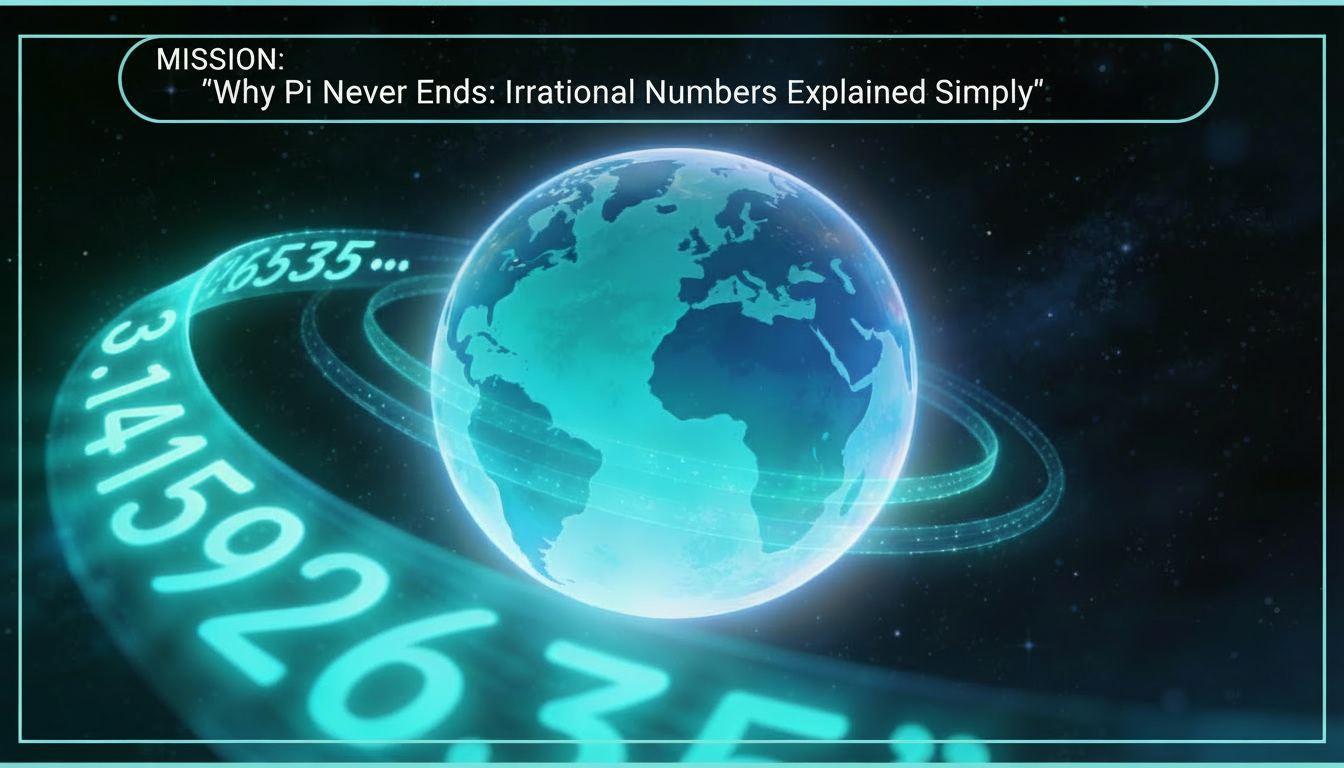
π≈3.141592653589793…
The three dots mean the digits go on forever. There is no last digit to reach. With infinite time and endless paper, you could keep writing pi’s digits but never finish.
There’s another twist: as far as anyone can tell (and computers have checked trillions of digits), the digits of pi never fall into a neat, repeating pattern. You do not suddenly hit a block like “1234” that repeats forever. This combination, never-ending and never repeating, is what signals that pi is something special: an irrational number.
Rational numbers: the “nice” decimals
To see what makes pi unusual, it helps to start with numbers that behave a little more politely: rational numbers.
A rational number is any number you can write as a fraction of two whole numbers. In symbols, that just means:
rational number=integer/integer
Some very familiar examples:
1/2= 0.5
1/4=0.25
5/8=0.625
These are the “easy” ones, where the decimal simply stops. You hit the last digit, and that’s the end of the story.
Other rational numbers don’t stop, but they do repeat:
1/3=0.3333… (a never‑ending string of 3s)
2/9=0.2222… (never-ending 2’s)
7/11=0.636363… (the pattern “63” repeats again and again)
Even when these decimals go on forever, you can see a definitive pattern: the same digit sequence repeats unchanged. That pattern signals the number is still rational, even if the decimal doesn’t terminate.
So rational numbers really come in two friendly categories:
Decimals that stop (like 0.5 or 0.25).
Decimals that repeat in a fixed pattern (like 0.3333… or 0.636363…) contrast with decimals that never repeat. This difference marks the key boundary between rational and irrational numbers.
Irrational numbers: endless, but pattern‑free
Irrational numbers break those rules: they cannot be written as a fraction of two whole numbers, and their decimals never settle into a repeating pattern. This lack of repetition sets them apart from rational numbers whose decimals either stop or repeat.
One classic example is the square root of 2:
2≈1.4142135623…
The digits continue endlessly, but if you look closely, they never settle into repetition like 0.3333… does. There’s never a sequence you can point out and say, “That chunk recurs now, again and again, all the way to infinity.”
Pi behaves the same way:
π≈3.14159265358979323846…
You can examine the decimal expansion as deeply as you want. You’ll see many segments—1415, 9265, 3589, and so on, but none repeat in a fixed, predictable pattern. Pi never becomes “3.1415926 789 789 789…” with a recurring “789,” nor is there a simple rule like “every third digit is 5.”
That lack of a repeating pattern is the defining feature that sets irrational numbers apart from rational numbers, whose decimals always stop or repeat.
Pi is the perfect “never‑ending” example.
This connection between pi and circles makes pi an especially nice example for discussing irrational numbers. It links abstract math with something we can picture every day: circles.
By definition,
π= circumference of a circle/diameter of that circle
Pick any circle you like, a coin, a dinner plate, a bicycle wheel, even the cross‑section of a planet, and measure:
The distance around the edge (the circumference).
The distance straight across through the center (the diameter).
If you divide the first by the second, you get pi. That ratio is a perfectly real, exact quantity, even though its decimal representation never settles into a neat pattern or terminates.
That leads to a subtle but important idea:
Pi is not “approximate” because the digits go on forever.
Pi itself is exact; it’s our decimal system that can only ever approach it.
So when people say “pi is about 3.14,” they mean that 3.14 is a rounded version of a number with an infinite number of digits.
Side by side: rational vs irrational
Putting some examples side by side helps the difference stick.
Rational numbers
1/2=0.5
Decimal stops.
3/4=0.75
Decimal stops.
1/3=0.3333…
Decimal continues forever, repeating the digit 3.
5/11=0.454545…
Decimal continues forever, repeating the block “45.”
Each of these can be written simply as a fraction of whole numbers, unlike some decimals that are endless and unpredictable. The decimals here may seem long, but they’re orderly and predictable.
Irrational numbers
π≈3.1415926535…
square root of 2≈1.4142135623…
square root of 3≈1.7320508075…
For these numbers, the decimals:
Go on forever.
Do not fall into a repeating pattern.
Cannot be written as a simple fraction a/b with whole numbers a and b.
That repeating vs. non-repeating line separates rationals from irrationals.
Why pi’s endless digits actually matter
It’s tempting to consider pi’s infinite digits as an odd bit of trivia, mostly appealing to those who compete in digit‑reciting contests. But the fact that pi never ends and never repeats has real mathematical significance.
1. Hidden complexity in simple shapes
Circles are simple, but the number describing them, pi, has an endless, non-repeating sequence of digits.
That contrast sends a useful signal:
Simple shapes can hide deep mathematics.
Very basic ideas in geometry can lead straight into infinity.
For many students, that’s the first time they see “simple picture” and “infinite complexity” living side by side.
2. A stress test for our decimal system
Base-10 decimals are handy, but pi shows their limits; some numbers aren’t tidy or finite.
You can get closer:
3.1
3.14
3.141
3.1415
3.14159
Each step increases precision, but none of these equals pi exactly. The true value always lies just beyond your last written digit.
Learning that numbers can be approximated more and more closely, but not exactly, is a leap in mathematical maturity that introduces the concept of limits.
3. From infinity to real‑world calculations
In everyday work, nobody needs every digit of pi. Engineers, scientists, and teachers pick a level of precision that’s good enough for the task:
For a school geometry problem, using 3.14 is usually fine.
For more sensitive calculations, 3.14159 or 3.14159265 may be used.
Pi may be infinite, but the digits you need in practice are finite. That’s a clear way to show students math can address infinity without confusion: there’s order, and there are logical stopping points.
A few digit sequences to make it visual
Short digit strings make the abstract definitions feel more concrete.
Rationale for repeating decimals
1/3:
Decimal: 0.333333…
Pattern: a single digit, 3, repeats forever.
2/7:
Decimal: 0.285714285714…
Pattern: the six‑digit block “285714” repeats.
If you kept writing, the identical block would recur in the same order.
Irrational: pi
π: starts 3.141592653589793…
If you read pi’s digits, you see chunks but no repeating cycle, unlike “285714” in 2/7.
. The digits behave more like a never‑ending, pattern‑less stream, at least from what anyone has yet discovered.
That visual distinction, predictable repetition versus endlessly shifting digits, is what “irrational” means in practical terms.
Talking about irrational numbers with people of different ages
Pi is famous, and that makes it a flexible teaching tool.
For younger learners:
Focus on the story: pi is the number you get when you compare “around a circle” to “across a circle.”
If you write pi as a decimal, the digits keep going like a book that never reaches its last chapter.
Use pictures, measurements, and simple language instead of heavy symbols.
For older students and adults:
Emphasize the formal idea: irrational numbers cannot be written as fractions of whole numbers.
Show short decimal snippets of rational and irrational numbers and ask: “Do you see repetition or not?”
In any setting, pi’s endless digits help illustrate infinity and number system richness.
Bringing it all together
Pi never ends because it is an irrational number: its decimal expansion goes on forever, never settles into a repeating pattern, and cannot be captured as a simple fraction of whole numbers. Rational numbers, like 1/2 or 1/3, either stop or repeat; irrational numbers like π and the square root of 2 do neither.
Starting with pi’s digits turns a dull “3.14 fact” into a doorway. Students move from memorizing a couple of digits to seeing that some numbers are simply too rich to fit inside a finite decimal, yet they still describe very real, very down‑to‑earth things, like the geometry of a circle or the diagonal of a square. That’s where the topic stops being just about a symbol on the board and starts to feel like a genuine piece of how the world fits together.